The Greek government has formally adopted a new, and long-awaited, national development framework to guide tourism investment around the country with the aim of ensuring the future sustainability of the sector.
The joint ministerial decree sets planning rules that seek to balance tourism development with protections for the environment, local communities and the unique cultural characteristics of destinations.
Greece is one of the world’s Top 10 tourism destinations with the tourism sector accounting for roughly one-fifth of Greece’s economy. It has hosted a steadily growing number of visitors each year and in 2025 attracted a record 38 million visitors and collected almost €24 billion in travel receipts. Consequently, Greece has also attracted significant foreign investment to its hospitality sector with hundreds of new hotels opening over the last several years and, by some estimates, approximately €12 billion in hotel investments.
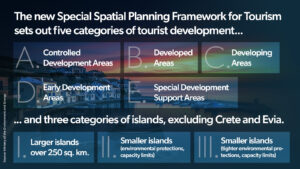
In an effort to diversify Greece’s tourism destinations and its tourism product, the new Special Spatial Framework for Tourism creates five categories for the country’s mainland areas, and three classifications for the islands based on the level of existing tourism activity. Taking into account factors like number of accommodations, land area and resident population, the classifications set conditions for further tourism development. This includes the types of projects permitted and, for new hotel or related investments, sets thresholds for minimum land requirements, capacity to accommodate visitors and environmental protections, among other things.
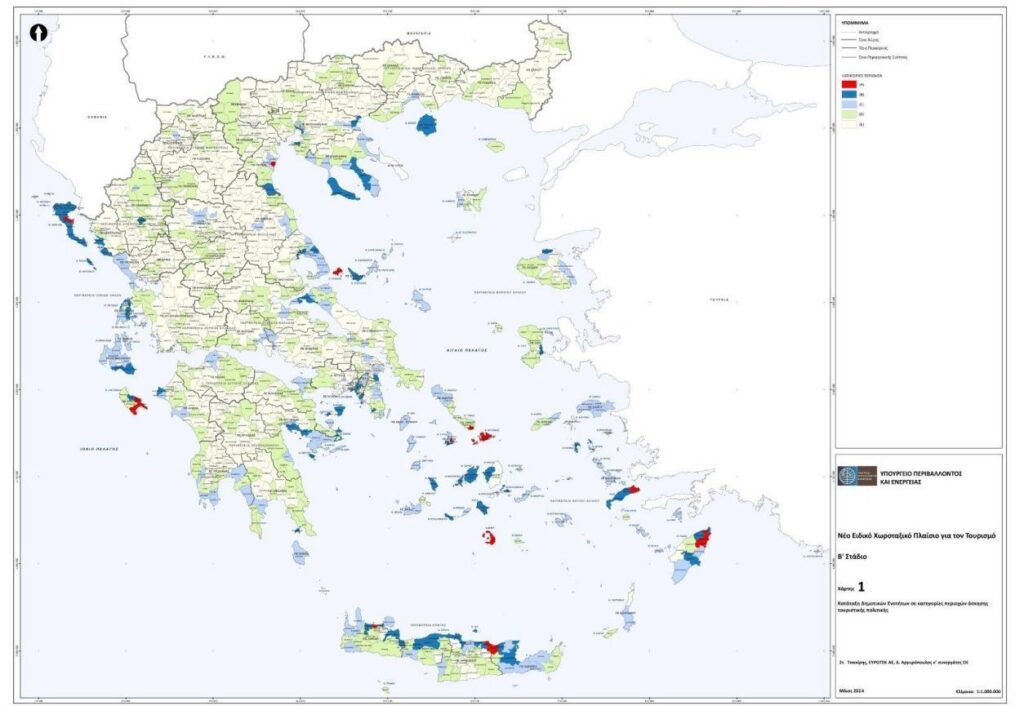
Areas are divided into five categories:
• A: Controlled Development Areas
Areas with very high tourism pressure, where priority is given to upgrading existing accommodation and stricter rules apply to new tourism developments. New hotels built outside town plans will require a minimum land plot of 16 stremmas (1.6 hectares).
• B: Developed Areas
Areas where tourism development continues with fewer restrictions and greater emphasis on quality upgrades, special-interest tourism and modern infrastructure. New hotels built outside town plans will require a minimum land plot of 12 stremmas (1.2 hectares).
• C: Developing Areas
Areas where additional tourism development is encouraged in order to gradually strengthen the local tourism product.
• D: Early Development Areas
Areas where the focus is on mild tourism growth and the development of new destinations based on local characteristics.
• E: Special Development Enhancement Areas
Areas mainly intended for special forms of tourism such as mountain, wellness, marine and diving tourism.