The Greek government has formally adopted a new, and long-awaited, national development framework to guide tourism investment around the country with the aim of ensuring the future sustainability of the sector.
The joint ministerial decree sets planning rules that seek to balance tourism development with protections for the environment, local communities and the unique cultural characteristics of destinations.
Greece is one of the world’s Top 10 tourism destinations with the tourism sector accounting for roughly one-fifth of Greece’s economy. It has hosted a steadily growing number of visitors each year and in 2025 attracted a record 38 million visitors and collected almost €24 billion in travel receipts. Consequently, Greece has also attracted significant foreign investment to its hospitality sector with hundreds of new hotels opening over the last several years and, by some estimates, approximately €12 billion in hotel investments.
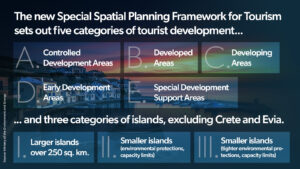
In an effort to diversify Greece’s tourism destinations and its tourism product, the new Special Spatial Framework for Tourism creates five categories for the country’s mainland areas, and three classifications for the islands based on the level of existing tourism activity. Taking into account factors like number of accommodations, land area and resident population, the classifications set conditions for further tourism development. This includes the types of projects permitted and, for new hotel or related investments, sets thresholds for minimum land requirements, capacity to accommodate visitors and environmental protections, among other things.
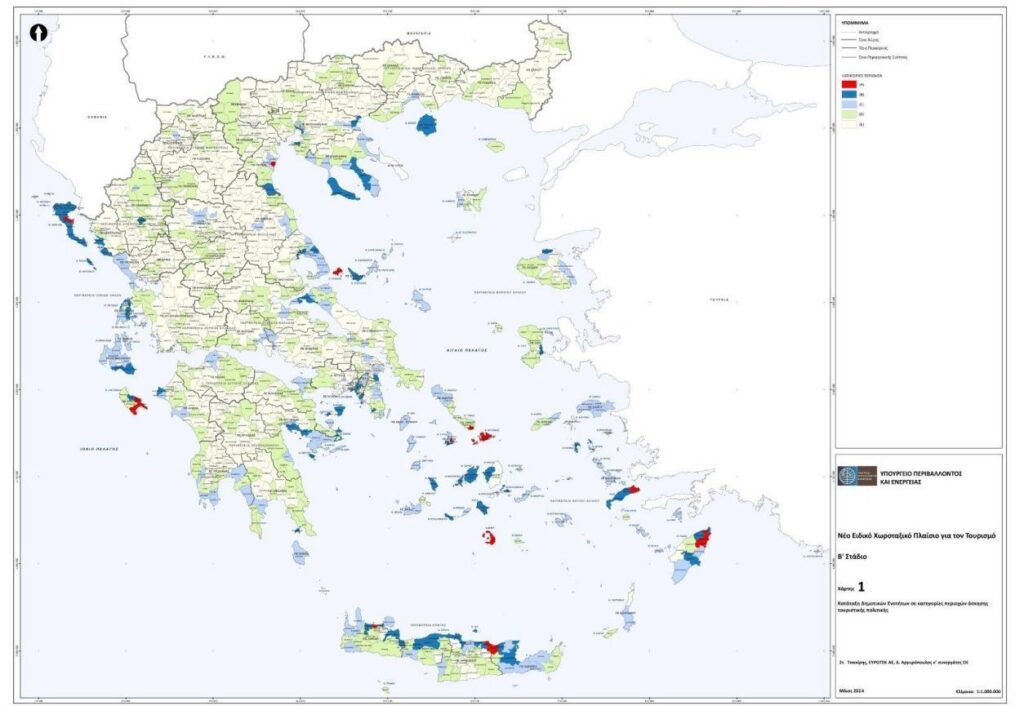
Areas are divided into five categories:
• A: Controlled Development Areas
Areas with very high tourism pressure, where priority is given to upgrading existing accommodation and stricter rules apply to new tourism developments. New hotels built outside town plans will require a minimum land plot of 16 stremmas (1.6 hectares).
• B: Developed Areas
Areas where tourism development continues with fewer restrictions and greater emphasis on quality upgrades, special-interest tourism and modern infrastructure. New hotels built outside town plans will require a minimum land plot of 12 stremmas (1.2 hectares).
• C: Developing Areas
Areas where additional tourism development is encouraged in order to gradually strengthen the local tourism product.
• D: Early Development Areas
Areas where the focus is on mild tourism growth and the development of new destinations based on local characteristics.
• E: Special Development Enhancement Areas
Areas mainly intended for special forms of tourism such as mountain, wellness, marine and diving tourism.
 Welcome to our cherished heritage property, a place where cherished memories and family history intertwine. This house holds a special place in our hearts as it is a legacy passed down from my beloved father. With great love and respect, we have meticulously renovated and restored this home, ensuring that its character and charm remain intact while offering modern comfort. Each corner of this house tells a story, and we invite you to create your own unforgettable moments within its walls. As you stay here, we hope you feel the warmth and love that we have poured into this place, honouring the memory of our father and creating a space for new memories to be cherished for years to come.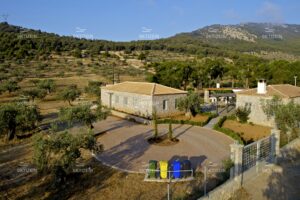
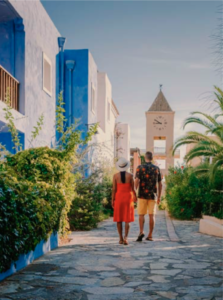 Λιγότερα χρήματα ξοδεύουν πλέον οι ξένοι τουρίστες που επισκέπτονται την Ελλάδα σε σύγκριση με δέκα χρόνια πριν. Την ίδια στιγμή, η χώρα μας -σε σχέση με τους κύριους ανταγωνιστές της- δε φαίνεται να συγκαταλέγεται στους φθηνούς προορισμούς αφού στις περισσότερες περιπτώσεις οι ευρωπαίοι τουρίστες στην Ελλάδα δαπανούν περίπου τα ίδια, εάν όχι και περισσότερα χρήματα.
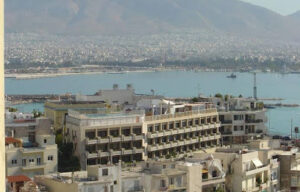 Το Hampton by Hilton Piraeus Μικρολίμανο θα βρίσκεται στην Καστέλλα, κοντά στη μαρίνα του Μικρολίμανου με εκπληκτική θέα στο λιμάνι. Μετά από την ανακαίνιση ύψους 5,5 εκατ. ευρώ στην οποία θα προχωρήσει ο όμιλος SCD, το Hampton by Hilton Piraeus Μικρολίμανο θα προσφέρει τη διεθνώς αναγνωρισμένη και υψηλής ποιότητας φιλοξενία των ξενοδοχείων Hampton by Hilton.
 The Greek government has announced the phased restart of the country’s all important tourism sector by opening up the country to visitors from June, and supporting local businesses ahead of the traditional summer tourist season.